
- About Us
- Calendar & Events
- Get Involved
- Resources
- Programs
- KCSARC Community
- Contact Us
Prevention
Preventing sexual violence is at the core of KCSARC’s mission. As an agency, we ultimately want to eliminate sexual assault and ensure the freedom to live without fear. Recognizing the complexity of this goal, KCSARC pursues a multi-faceted approach to prevention based on three primary assumptions:
- Prevention must take place on many levels and take into account individual, relationship, community, and societal factors that lead to violence.
- Prevention work is effective at any point on the service continuum.
- Education helps people learn about conditions; prevention helps them change those conditions that lead to sexual violence.
Information and Services:
- Consultation and Training Services
- Initiatives in Prevention
- Bullying and Anti-biased Harassment
- Internet Safety
- Sex Offender’s in the Community & Community Safety
Prevention must take plan on many levels and take into account individual, relationship, community, and societal factors that lead to violence.
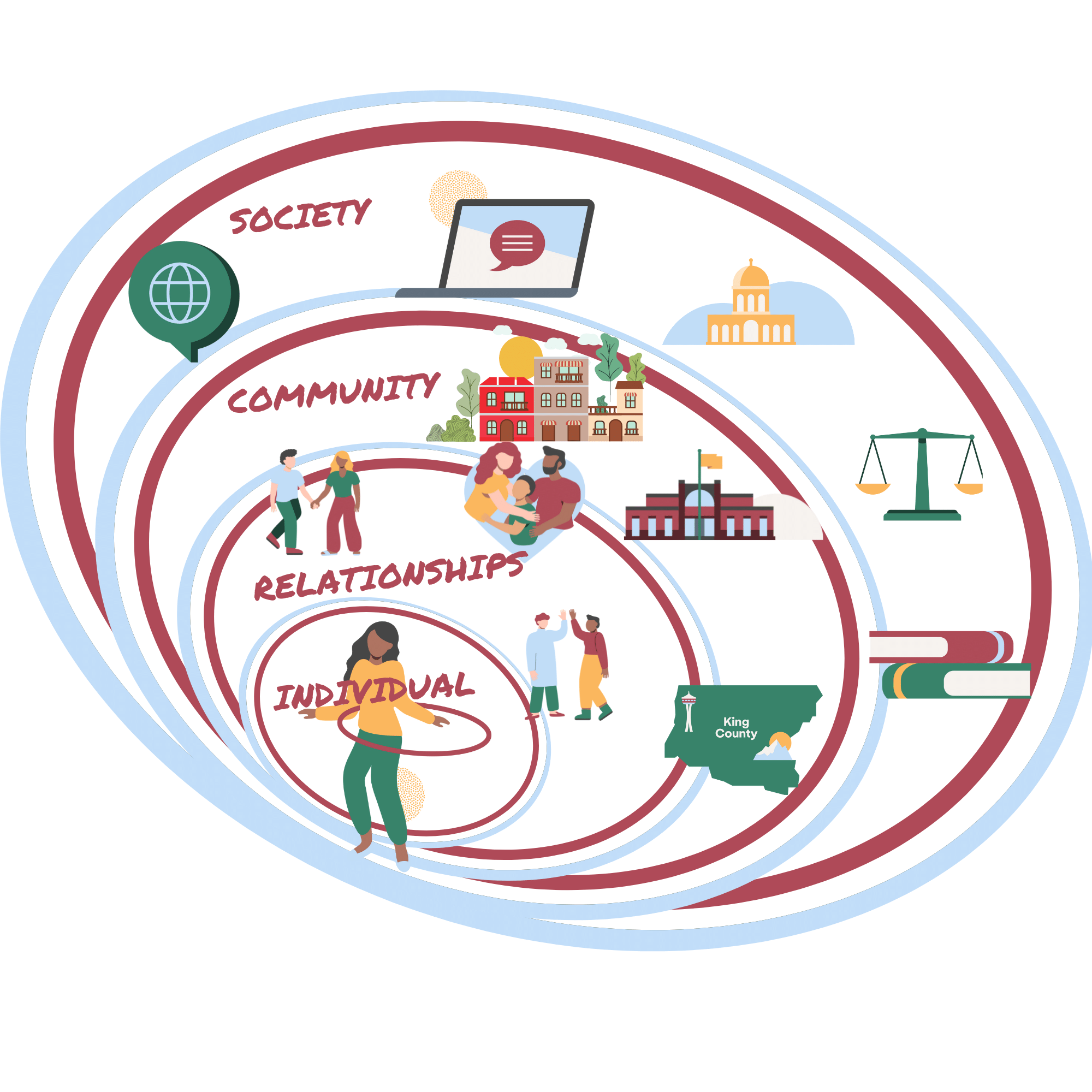
KCSARC utilizes the “Ecological Model,” developed by the Centers for Disease Control (Dahlberg & Krug 2002), as a framework for focusing its prevention work. This widely-utilized public health model of violence prevention recognizes the complex interplay between individual, relationship, community and societal factors that influence sexual violence.
Examples of KCSARC’s interventions at each level include:
- Individual-level: Counseling, therapy, and educational training sessions that focus on social and cognitive skills and behaviors. For example, in a school setting, a workshop might focus on student attitudes and beliefs regarding sexual violence, such as the commonly held belief that that girls and women “ask” to be raped if they dress provocatively.
- Relationship-level: Family therapy and mentoring and peer programs designed to reduce conflict, foster problem solving skills, and promote healthy relationships. For example, KCSARC provides parent education designed to help parents and guardians create appropriate boundaries and discipline that helps increase the bond between parent and child and ultimately promotes child safety.
- Community-level: Interventions designed to impact the climate, systems, and policies in a given setting, such as a school, faith community, or business. For example, helping a school develop anti-bullying and harassment policies will send the message that these behaviors are not tolerated and carry clearly-defined consequences.
- Societal-level: Interventions typically involve collaborations by multiple partners to change laws and policies related to sexual violence or gender inequality or to identify strategies for changing social norms that accept violence.
Prevention work is effective at any point on the service continuum.
We traditionally think of prevention as taking place before something bad has happened. For example, KCSARC might deliver a seminar to group of parents and guardians on how to recognize “grooming” techniques that perpetrators use to lure children. This type of seminar helps parents take steps to protect their children and prevent such violence from occurring.
However, prevention can be equally effective with populations who have already been victimized. In these cases, prevention helps alleviate some of the long-term consequences of violence, such as mental health problems, that can place victims at higher risk for future assault. Prevention efforts, such as therapy, promote healing that disrupts this pattern.
An effective approach to prevention is targeting groups that have been identified as being at heightened risk for sexual violence perpetration or victimization. For example, KCSARC’s new Internet Safety Program targets specific groups of youth who have been identified through research as being at greater risk for sexual victimization perpetrated over the Internet.
Education helps people learn about conditions; prevention helps them change those conditions that lead to sexual violence.
KCSARC works to educate the community and to lead and facilitate prevention efforts to end sexual violence. Example of corresponding educational and prevention efforts include:
- Skill building and training leads to Dialogues on sexual violence and societal norms that ultimately challenge prevailing attitudes towards violence and gender norms.
- Distribution of materials leads to Community notification meetings about returning sex offenders which help neighbors address safety issues in their own communities.
- Community events lead to community advocacy and safety projects Dialogue with local elected officials and legislators leads to development of policies, procedures, laws and bills.
Summary
Extensive research by the Prevention Institute—a national organization dedicated to advancing prevention efforts that address multiple problems concurrently—lends credence to approaching sexual violence through the Ecological Model. This model provides us with a framework for understanding how individual-level influences are deeply rooted within family, community, and societal levels. We must address all of these levels in order to understand and deal with the complex array of factors that lead to perpetrating or being at higher risk for sexual violence. KCSARC works at every level—from being at the forefront of policy development to working one-on-one with high risk youth—to create change in beliefs, attitudes and behaviors about violence.